
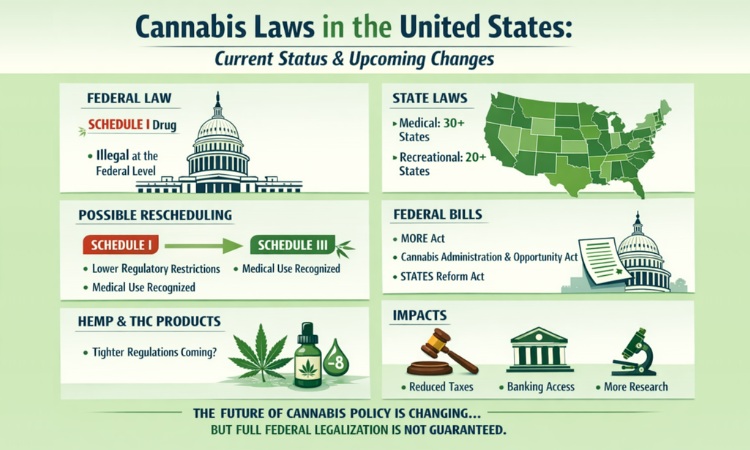
Cannabis legislation in the United States is complex and constantly evolving. While many U.S. states have legalized cannabis for medical and/or recreational use, federal law still largely prohibits it. This legal contradiction has shaped the cannabis industry for years—but major changes may be on the horizon.
Federal Law: Cannabis Remains Largely Illegal
At the federal level, cannabis is currently classified as a Schedule I substance under the Controlled Substances Act (CSA). This category is reserved for drugs considered to have a high potential for abuse and no accepted medical use, placing cannabis in the same legal category as heroin.
As a result:
- The production, possession, and distribution of cannabis remain illegal under federal law.
- Cannabis businesses face limited access to banking and financial services.
- Section 280E of the U.S. tax code prevents cannabis companies from deducting normal business expenses, leading to significantly higher effective tax rates.
Despite widespread state-level legalization, federal prohibition continues to create legal and financial uncertainty.
State-Level Legalization: A Growing Majority
In contrast to federal law, individual U.S. states have increasingly embraced cannabis reform:
- Medical cannabis is legal in more than 30 states and Washington, D.C.
- Recreational (adult-use) cannabis is legal in over 20 states and D.C., typically for adults aged 21 and over.
Each state sets its own rules regarding possession limits, home cultivation, retail sales, and licensing. As a result, cannabis can be legal in one state and illegal in a neighboring one, even though both are subject to the same federal laws.
Major Potential Shift: Federal Rescheduling
One of the most significant recent developments is the potential rescheduling of cannabis under federal law, from Schedule I to Schedule III.
The U.S. Department of Justice and the Drug Enforcement Administration (DEA) are currently reviewing a proposal to move cannabis from Schedule I to Schedule III of the Controlled Substances Act.
If implemented, this change would:
- Officially acknowledge that cannabis has accepted medical uses.
- Make scientific and medical research significantly easier.
- Potentially eliminate the application of IRS Section 280E for cannabis businesses, providing major tax relief.
However, it is important to note that rescheduling is not the same as full federal legalization. Cannabis would remain regulated and controlled at the federal level.
Federal Cannabis Reform Bills
Several bills in Congress aim to further reform federal cannabis policy:
CANNABIS ADMINISTRATION AND OPPORTUNITY ACT:
Would remove cannabis from the Controlled Substances Act entirely and establish a comprehensive federal regulatory framework.:
STATES REFORM ACT:
Seeks to protect state-legal cannabis activities from federal interference while preserving state authority over cannabis regulation.
MORE ACT (MARIJUANA OPPORTUNITY REINVESTMENT AND EXPUNGEMENT ACT):
Proposes full federal decriminalization of cannabis, expungement of certain prior convictions, and reinvestment in communities disproportionately impacted by the war on drugs.
While these proposals have gained attention, most face political hurdles and uncertain timelines for passage.
Hemp and THC-Derived Products
In addition to marijuana, federal law distinguishes hemp—defined as cannabis containing no more than 0.3% delta-9 THC on a dry-weight basis.
However, concerns over intoxicating hemp-derived products (such as Delta-8 THC) have prompted calls for tighter regulation. Future federal or state-level changes may restrict or ban certain hemp-derived cannabinoids, which could significantly impact parts of the cannabis and CBD markets.
Implications for Consumers, Businesses, and Research
CONSUMERS
- Cannabis use remains technically illegal under federal law, even in legal states.
- Rescheduling could reduce stigma and expand access to medical cannabis treatments.
BUSINESSES
- Potential tax relief and improved access to banking would significantly benefit the cannabis industry.
- Regulatory uncertainty, especially around hemp-derived products, remains a challenge.
RESEARCHERS
- Rescheduling would reduce administrative barriers, enabling more clinical trials and scientific studies on cannabis and its medical applications.
Conclusion
Cannabis regulation in the United States is at a pivotal moment. While state-level legalization continues to expand, federal policy has lagged behind. Potential rescheduling, combined with ongoing legislative efforts, suggests a gradual shift toward a more unified and pragmatic approach.
However, full federal legalization is not yet guaranteed. Until then, the U.S. cannabis landscape will continue to be defined by a complex patchwork of state laws, federal restrictions, and evolving political priorities.
For consumers, entrepreneurs, and policymakers alike, the coming years may prove decisive in shaping the future of cannabis in the United States.